

INTRODUCTION
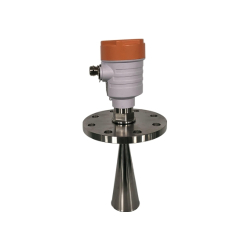
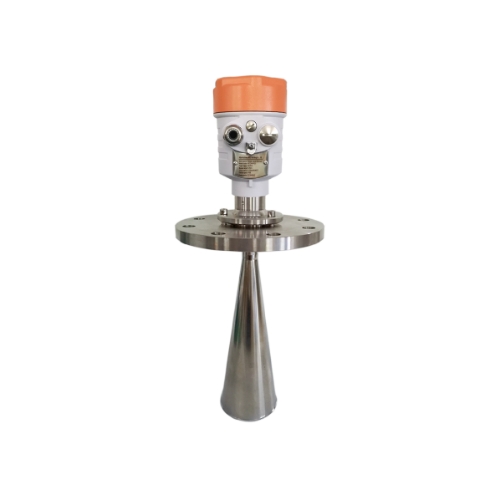
HCDAR-63 Radar Level Sensor for Solid Particle & Powder | Dust-Resistant Silo Level Measurement – HCCK
- Application: Solid Particle, Solid Powder, All kinds Of Dust Environment
- Measuring Range: 0~70m
- Connection Process: Flange
- Medium Temperature: (-40~250)℃
- Process Pressure: (-0.1~2)MPa Directional
- Accuracy: ±15mm
- Signal Output: (4~20)mA HART/RS485 MODBUS
- Explosion-Proof Grade: Ex ia IIC T1-T6 Ga/Ex d IIC T6 Gb
- Protection Grade: IP68
- Frequency Range: 26 GHz
HCDAR-6x series adopts non-contact measuring method, the output (4-20) mA/RS485 signal, max measuring range is 70m.
The antenna structure is further optimized, and the new microprocessor can perform higher-speed signal analysis and processing.
The instrument can be used in more complicated working conditions such as reactors or solid silos.
WORKING PRINCIPLE
The antenna of HCDAR-6x launches a narrow pulse electromagnetic wave, and electromagnetic wave is reflected back when reach the medium surface and received by the same antenna.
According to the two pulse interval, the microprocessor calculates the distance from the antenna to the surface of the measured medium, and convert it into material level signal.
FEATURE
HCDAR-6x series has small beam angles, and strong anti-interference ability, which improves measurement accuracy and reliability.
The antenna size is smaller, easy to install. It has small measuring blind zone and shorter wavelength.
HCDAR-6X has a good measurement effect for small tanks and small particles. Non-contact measurement, no wear, no pollution.
Output option: 2-wire (4-20 )mA HART and 4-wire RS485 Modbus.
HCDAR-63 Radar Level Sensor for Solid Particle & Powder | Dust-Resistant Silo Level Measurement – HCCK
- HCDAR-61 Radar Level Sensor for Corrosive Liquids
- HCDAR-62 Radar Level Sensor for Liquid & Slurry
- HCDAR-63 Radar Level Sensor for Solid Particle & Powder
- HCDAR-64 Radar Level Sensor for Solid Material & Powder
- HCDAR-65 Radar Level Sensor for River, Reservoir, Lake & Tide Monitoring
- HCDAR-66 Radar Level Sensor for Liquid, Slurry & Dew Resistant
- HCDAR-67 Radar Level Sensor Liquid, Slurry, Steam, Condensation Occasions
HCDAR-63 Radar Level Sensor for Solid Particle, Solid Powder & Dusty Environments
Advanced Industrial Radar Level Measurement by HCCK (Hebei Huachuang M&C Technology Co., Ltd.)
Accurate level measurement of solid particles, powders, and bulk materials is a major challenge in modern industrial storage and processing systems. Many industries handle materials that generate large amounts of dust, form irregular surfaces, or create unstable filling patterns inside storage containers.
Industries such as cement manufacturing, mining, grain storage, fertilizer production, and chemical processing depend on reliable level monitoring to maintain safe operations and efficient inventory management.
Traditional level measurement technologies often struggle in these environments. Mechanical level sensors can fail due to wear and tear. Ultrasonic sensors may produce inaccurate readings when dust interferes with sound waves. Capacitance probes may require frequent recalibration due to changes in material properties.
To overcome these limitations, HCCK (Hebei Huachuang M&C Technology Co., Ltd.) has developed the HCDAR-63 Radar Level Sensor, a high-performance industrial radar transmitter designed for solid particle measurement, powder storage monitoring, and environments with heavy dust.
Using advanced microwave radar technology, the HCDAR-63 provides stable, accurate, and reliable level measurement for bulk materials in demanding industrial conditions.
The sensor is widely used in silos, hoppers, storage tanks, and bulk material containers across many industries worldwide.
What is the HCDAR-63 Radar Level Sensor?
The HCDAR-63 Radar Level Sensor is a non-contact radar level transmitter designed to continuously monitor the level of solid materials inside industrial storage systems.
The sensor works by emitting high-frequency radar signals from its antenna toward the material surface. When the radar signal reaches the surface of the stored material, it reflects back to the sensor.
By measuring the time required for the signal to return, the device calculates the distance between the sensor and the material surface. This distance is then converted into an accurate level measurement.
Because radar signals are not significantly affected by environmental factors such as dust, temperature, pressure, or humidity, the HCDAR-63 can deliver reliable measurement performance in environments where other technologies fail.
Why Radar Level Sensors Are Ideal for Solid Material Measurement
Radar technology has become the preferred method for monitoring solid materials in industrial storage systems.
Several characteristics make radar sensors particularly effective in these applications.
Resistance to Dust Interference
In industries that handle powdered materials, dust clouds are common during filling or discharge operations.
Radar signals can penetrate dust particles and still detect the material surface accurately.
Non-Contact Measurement
Radar sensors measure levels without touching the material, eliminating issues such as:
-
material buildup on probes
-
mechanical damage
-
corrosion
-
sensor contamination
Reliable Performance in Harsh Conditions
Radar sensors maintain measurement stability despite extreme environmental conditions.
Long-Term Durability
Because radar sensors contain no moving parts, they provide long service life and reduced maintenance requirements.
Key Features of the HCDAR-63 Radar Level Sensor
High-Frequency Radar Technology
The HCDAR-63 radar level sensor uses advanced microwave radar technology to provide high-resolution level measurements.
The strong radar signal reflection ensures accurate detection of material surfaces even in challenging storage conditions.
Designed for Dusty Environments
Many industrial processes produce significant amounts of dust. Cement production, grain handling, coal storage, and mineral processing are common examples.
The HCDAR-63 radar level sensor is specifically engineered to maintain measurement accuracy in environments with heavy airborne dust.
Accurate Measurement of Solid Particles and Powders
Bulk materials often create irregular surfaces due to natural piling angles.
The HCDAR-63 sensor uses advanced signal processing algorithms to determine the correct material surface level even when surfaces are uneven or sloped.
Long Measurement Range for Industrial Silos
The HCDAR-63 radar sensor supports long measurement ranges, making it ideal for large industrial storage containers such as:
-
cement silos
-
grain silos
-
mining storage bins
-
chemical powder tanks
-
fertilizer storage systems
Strong Signal Penetration
High-frequency radar waves provide strong signal penetration through dust clouds and vapor.
This allows the sensor to maintain stable measurements even during active filling processes.
Low Maintenance Design
Industrial facilities prefer equipment that requires minimal maintenance.
Because the HCDAR-63 radar sensor has no moving components and does not contact stored materials, maintenance requirements are extremely low.
Industrial Applications of the HCDAR-63 Radar Level Sensor
The HCDAR-63 radar level sensor is used in many industries where reliable monitoring of solid materials is required.
Cement Manufacturing
Cement plants store large quantities of powdered raw materials such as cement clinker, limestone powder, and fly ash.
These materials create heavy dust during storage and transfer operations.
The HCDAR-63 radar level sensor provides reliable level measurement in cement silos, improving inventory monitoring and operational efficiency.
Mining and Mineral Processing
Mining facilities handle bulk solids such as coal, iron ore, limestone, and crushed minerals.
The HCDAR-63 radar sensor can measure levels in storage bins, crushers, and transfer hoppers.
Grain Storage and Agriculture
Grain storage facilities rely on accurate monitoring of silo levels to optimize storage capacity and prevent overflow.
The radar sensor performs reliably even in dusty grain handling environments.
Chemical Industry
Chemical plants often store powdered raw materials used in manufacturing processes.
The non-contact design of the radar sensor ensures safe measurement without contamination.
Power Generation Plants
Coal-fired power plants store large quantities of coal in silos or bunkers.
The HCDAR-63 radar level sensor allows accurate monitoring of fuel storage levels.
Radar Level Sensors vs Other Measurement Technologies
Radar vs Ultrasonic Sensors
Ultrasonic sensors rely on sound waves that can be disrupted by dust particles and airflow.
Radar sensors are significantly less affected by these conditions.
Radar vs Capacitance Sensors
Capacitance sensors depend on the electrical properties of materials. Variations in moisture or density may affect measurement accuracy.
Radar sensors operate independently of these material characteristics.
Radar vs Mechanical Level Sensors
Mechanical sensors contain moving parts that may become damaged or stuck due to material buildup.
Radar sensors eliminate these risks.
Technical Advantages of the HCDAR-63 Radar Level Sensor
The HCDAR-63 offers multiple technical benefits that improve measurement reliability.
Stable Measurement Performance
Radar signals remain stable despite environmental disturbances.
Advanced Signal Processing
The sensor uses intelligent algorithms to filter noise and detect accurate surface reflections.
Strong Reflection Capability
High-frequency radar waves generate strong reflection signals from bulk materials.
Industrial Automation Compatibility
The sensor can be integrated with modern industrial control systems.
Installation of the HCDAR-63 Radar Level Sensor
The installation process is simple and flexible.
The sensor is typically mounted on top of storage containers such as:
-
silos
-
hoppers
-
bulk storage tanks
-
material bins
The radar beam should be directed toward the material surface without obstruction.
Once installed, the device can be connected to automation systems for continuous monitoring.
Operational Benefits for Industrial Facilities
Implementing the HCDAR-63 radar level sensor provides several operational advantages.
Improved Inventory Monitoring
Operators can track material quantities accurately in real time.
Increased Production Efficiency
Reliable level measurement improves production planning and material supply management.
Reduced Maintenance Costs
The non-contact measurement design eliminates many maintenance issues.
Improved Safety
Accurate level monitoring prevents silo overfilling and material spillage.
About HCCK (Hebei Huachuang M&C Technology Co., Ltd.)
HCCK (Hebei Huachuang M&C Technology Co., Ltd.) is a professional manufacturer specializing in industrial measurement and automation instrumentation.
The company develops advanced sensors used in:
-
industrial automation systems
-
environmental monitoring
-
water management solutions
-
process control industries
HCCK products are known for their reliability, precision, and ability to operate in demanding industrial environments.
Frequently Asked Questions (FAQ)
What materials can the HCDAR-63 radar level sensor measure?
The sensor can measure a wide range of materials including powders, granules, pellets, grains, coal, minerals, and other bulk solids.
Is the sensor suitable for dusty environments?
Yes. The HCDAR-63 radar level sensor is specifically designed for environments with heavy dust.
Does the sensor require contact with the material?
No. The sensor uses non-contact radar measurement technology.
Can it measure tall industrial silos?
Yes. The HCDAR-63 supports long measurement ranges suitable for large storage silos.
How often does the sensor require maintenance?
Very rarely. Because the sensor has no moving parts, maintenance requirements are minimal.
Conclusion
The HCDAR-63 Radar Level Sensor for Solid Particle, Solid Powder, and Dusty Environments from HCCK (Hebei Huachuang M&C Technology Co., Ltd.) provides a reliable and advanced solution for industrial level measurement.
With its high-frequency radar technology, strong dust penetration capability, long measurement range, and non-contact measurement design, the sensor ensures accurate monitoring of bulk materials in even the most challenging industrial environments.
Industries including cement manufacturing, mining, agriculture, chemical processing, and power generation can benefit from implementing this advanced radar level sensor to improve operational efficiency, safety, and inventory management.


 PT Totalitas Teknik Indonesia
 PT Totalitas Teknik Indonesia
 PT Totalitas Teknik Indonesia